
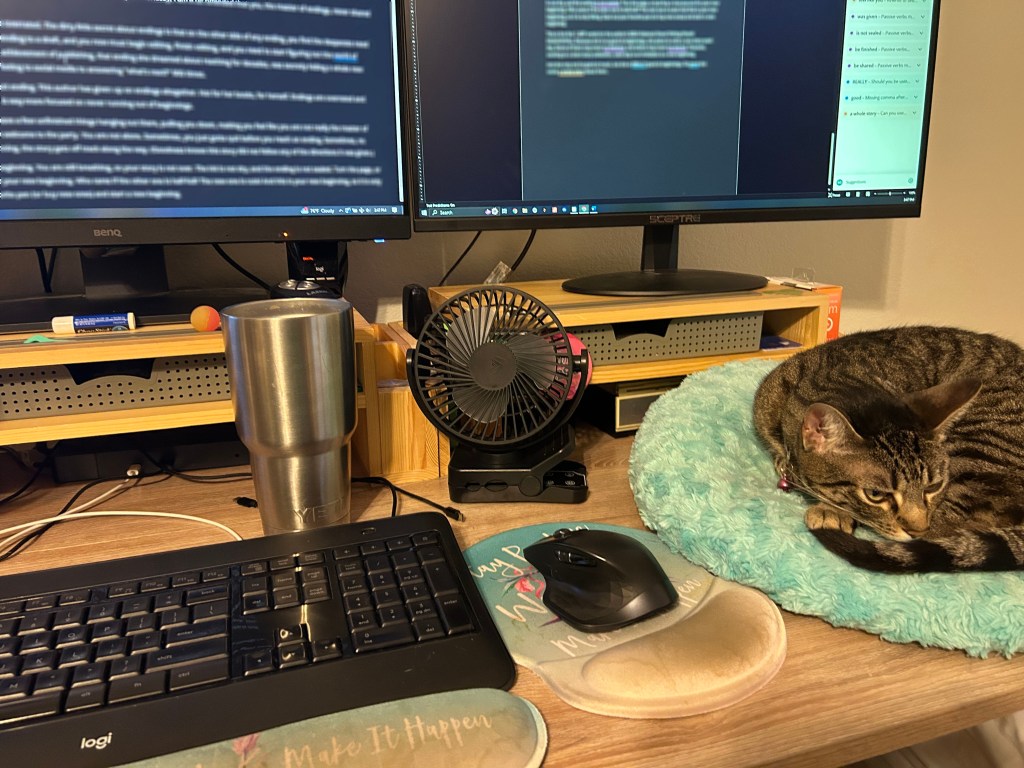
This is a story about beginnings by an author who doesn’t know how to finish anything. She has always loved a good ending in other people’s books. But she never seems able to end any of her own.
Maybe she is distracted by new, shiny ideas. Or she could be overwhelmed by life and pulled away from the project. But maybe it is just because endings are so stinking hard!
Like seriously, have you ever tried to write an ending? They are just so… well, final.
Beginnings are full of hope and possibility. The fresh potential of a new story. It is like the smell of a new book. Or baby hair, if you like that kind of thing. (All these parents always talking about the smell of baby hair. The author smelled it once and does not really get the appeal.)
But endings are not like that. They, by definition, are the exact opposite. Where the beginning gives you limitless possibilities, the ending forces you to accept only one. Where beginnings are full of potential, the ending forces a choice.
And ending is not just hard for the author when it comes to writing. Maybe you are perfect. Maybe your crafting closet is not full of started cross stitches, pieced quilt blocks, and crochet scarves that were supposed to be made into blankets. Maybe you don’t have boxes of half-filled journals or a tower of “currently reading” books on your nightstand. You have probably never quit mowing halfway through your lawn, cleaned only half the bathroom, or washed half a sink of dishes.
No, you are a finisher, so this story is not about you. Just take all your self-righteous finishing energy and keep it to yourself. This story is about beginnings.
The author has done all of those things and more because she is a master of beginnings. She has started so many projects and left them unfinished that she allows them to shape her identity. She is a starter. She is a dreamer of dreams, a cutter of fabric, a buyer of yarn, a crafter of characters, a builder of worlds, and a stacker of dishes. But under that pretty little label, she knows it is all just obfuscating her real identity: she is a quitter.
Some of her sentences don’t even get periods Periods are so final There is nothing more that comes after To place a period is to accept that the sentence is over and no more can be stuffed into it
Every beginning is full of hope and possibility. Maybe Sarah will overcome her physical limitations to run the marathon. Travis might face his fear of commitment and propose to the girl he loves. This may be the year that Zach and Elizabeth will finally have that baby they have been trying for.
We all love a beginning. The premise. The promise. The possibility! But at some point, it gets… hard.
Sarah sprains her ankle. Travis loses the ring. Zach and Elizabeth have another negative pregnancy test … or perhaps a miscarriage. And then suddenly it is not so fun anymore.
Sure, we may like reading these stories, but no one wants to live them. The cross-stitch pattern stops matching the stitches, and it is impossible to know where it went off track. The quilt blocks are somehow not square, so they cannot be sewn together. The stitch count is off somewhere, and the blanket pulls to one side. The mower battery dies. The characters do not mesh, the world-building cracks, and the plot falls apart. The dishes get crusty or sticky, or one may even break.
So you quit.
Strike that. Not you; you are a finisher. But the author. She quits sometimes… lots of times… all the time. She is really good at it. It may be the only thing she feels like she has really mastered.
But after quitting, there is no ending. The marathon cannot be run, the proposal does not happen, and the baby will not come. Quitting in Act 2 means the story just kind of ends. It has no ending.
The author knows that void, the empty hole where an ending belongs. After all, she is a master quitter. She has a whole list of projects and stories stuck in Act 2 that she uses to beat herself into unconsciousness at night. And she wakes up every morning having to crawl out from under that pile of broken beginnings before she can start her day.
Some days, that pile is so big and so heavy she can barely crawl out from under it. And the only way she knows to get free from the weight of all those unfinished projects is to get excited about a new beginning. That is why the master quitter is also the master of beginnings. After all, to become a master at quitting, you must first become a master at beginning. (So do not feel bad if beginnings are not your thing; we already established you, dear reader, are a finisher.)
She crawls herself out from under the pile of unfinished crafting projects by buying all the materials to start a new one. She sweeps aside the unfinished stories by dreaming up a whole new world. She overcomes her self-loathing about quitting swimming by buying a bike. She buys a new book (or three… or one hundred). She brushes aside her failure to call someone every day by deciding to start writing handwritten letters instead. She even buys 100 stamps and some new stationery to prove her seriousness (and because she can’t find the stamps from last time).
And, with that, the story that has no ending has a new beginning. It is not the same beginning; that one is in the pile. This fresh and new beginning is free of all the broken hopes and dreams of the old one.
But something strange happens when you make enough beginnings. This is so bizarre it breaks the laws of physics, storytelling, and probably aerodynamics. (Not sure about that last one, but the word sure sounds fancy!) When you start with new beginnings enough times… No, wait, not you. You are a finisher.
When the author starts with enough new beginnings, she finds that somehow she has progressed toward her ending, even though it is a whole new beginning.
It does not really make sense, but maybe it does. Maybe the second day, trying to tackle that task from a new angle, has just a little bit of a head start because it is the second beginning. And then the third starts just a smidge ahead of that.
Beginning something new is easier than ending, so why not just decide to keep beginning again, and again, and again? That is where the crazy magic happens. Something so magical that it must be a fairy in a book—maybe she should write that book—it would be a fun new beginning.
She could write about the magical fairy who shows up when someone has enough beginnings stacked on top of each other and turns all those beginnings into an ending. Because that is the only way to tell a story about beginnings. You stack enough of those beginnings on top of each other until somehow there is a teetering pile so high it collapses in on itself and becomes an ending (specifics about fairy involvement are unknown).
That is her story—the story of how she began, and began again, and began again, and began again, and somehow, at the end, she had a book.
But here is the dirty little secret about endings. The one no one tells you. Honestly, I am a bit offended that you, the master of endings, never shared this insight with the rest of us.
In truth, endings are really quite overrated. The dirty little secret about endings is that on the other side of any ending, you find the desperate need for a new beginning. Write the ending to a draft, and you now must begin editing. Finish editing, and you need to start figuring out the world of publishing. Even the crowning achievement of publishing, that ending she dreamed about reaching for decades, was secretly hiding a whole new world of beginnings from marketing to social media to answering “what’s next?” 900 times.
So do not worry about the next ending. This author has given up on endings altogether. Not for her books, for herself. Endings are overrated and often disappointing. No, she is way more focused on never running out of beginnings.
And you? Well, maybe you have a few unfinished things hanging out there, pulling you down, making you feel like you are not really the master of endings. If that is true, then welcome to the party. You are not alone. Sometimes, you just gotta quit before you reach an ending. Sometimes, no matter how good the beginning, the story gets off track along the way. (Goodness knows this story did not follow any of the directions it was given.)
But you can make a new beginning. You are still breathing, so your story is not over. The ink is not dry, and the ending is not sealed. Turn the page, or just buy a new journal for your new beginning. Who cares if the other one is half-full? The new one is cute! And this is your new beginning, so it is only fitting. Bust out your favorite pen (or buy new ones) and start a new beginning.
This is the first 1,667 words for the author’s 2024 National Novel Writing Month (NaNoWriMo). Because she is so good at beginnings, she plans to write a new story each day. Some of them may never be finished, and others may never be shared. However, working on a short story collection, each day is an invitation to a new beginning.
And she may not be good at much, but she is REALLY good at beginnings. So good she wrote a whole story about them.



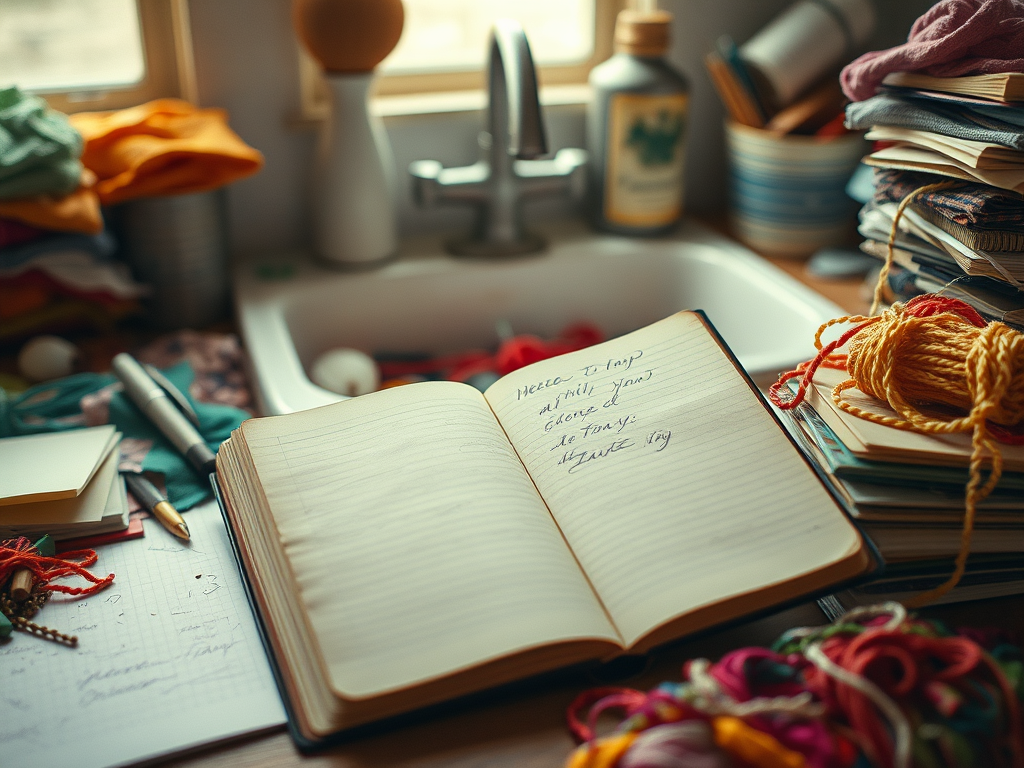
These images are AI generated by WordPress based on the contents of this post. It’s a new feature I have never tried before so I thought I would give it a shot.


 Imperfect Progress Titles
Leave a reply to Marianne Cancel reply